

Report Overview
The global 3D printing market size was valued at USD 16.75 billion in 2022 and is projected to grow at a compound annual growth rate (CAGR) of 23.3% from 2023 to 2030. The aggressive research & development in three-dimensional printing and the growing demand for prototyping applications from various industry verticals, particularly healthcare, automotive, and aerospace & defense, are expected to drive the growth of the market.
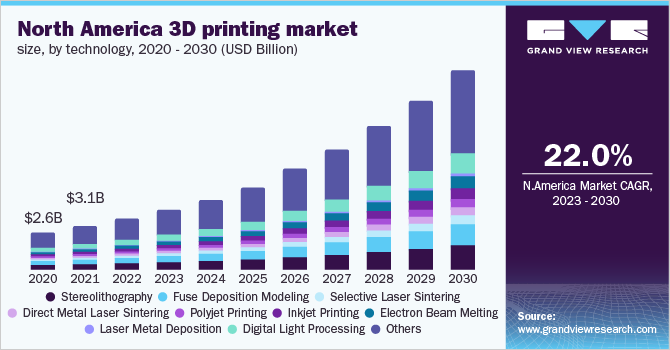
The use of 3D printing in industrial applications is usually referred to as additive manufacturing (AM). Additive manufacturing involves a layer-by-layer addition of material to form an object, referring to a three-dimensional file, with the help of software and a 3-dimensional printer. A relevant 3D printing technology is selected from the available set of technologies to implement the process. The last step involves the deployment of this process across different industry verticals based on the necessity.
The deployment includes providing installation services, offering consultation solutions, and customer support, as well as handling aspects related to copyrights, licensing, and patenting. 3D printing is benefiting manufacturers in terms of prototyping, designing of the structure and end products, modeling, and time to market. As a result, the production expenses have been reduced considerably, and the manufacturers are in a position to offer better products at reasonable prices. As a result of these benefits, the demand for 3D printers is expected to be triggered more in the coming years.
However, the prevailing misconceptions with respect to the prototyping processes held by small and medium-scale manufacturers are hindering the adoption of additive manufacturing. Companies involved in designing, particularly small-scale and medium-scale enterprises, are deliberating before considering investments in prototyping as accountable investments rather than trying to understand the advantages and benefits of prototyping. The general notion prevailing among these enterprises is that prototyping is merely an expensive phase prior to manufacturing. Such perceptions regarding prototyping, coupled with the lack of technical knowledge and a looming lack of standard process controls, are expected to hinder market growth.
The outbreak of the COVID-19 pandemic has significantly impacted the overall global economy and subsequently, the 3D printing industry. Initially, Europe and Asia Pacific were some of the worst affected regions in terms of the number of COVID-19 patients across the globe. Further, the situation worsened in the U.S. as well. Due to the rapid spread of the virus, the governments issued an order for the complete lockdown of some key cities. The complete lockdown affected the production of 3D printing manufacturers. This is attributed to the labor shortage and the complete disruption of logistics and supply chain in the nation. The halt in the production of 3D printing had an adverse impact on the overall market growth in the first and second quarters of 2020.
Printer Type Insights
The industrial printer segment led the market and accounted for more than 76.0% share of the global revenue in 2022. Based on the printer type, the industry has been further segmented into industrial and desktop 3D printers. The large share of industrial 3D printers can be attributed to the extensive adoption of industrial printers in heavy industries, such as automotive, electronics, aerospace and defense, and healthcare. Prototyping, designing, and tooling are some of the most common industrial applications across these industry verticals.
Extensive adoption of 3D printing for prototyping, designing, and tooling is contributing to the growing demand from the industrial sector. Hence, the industrial printers segment is expected to continue dominating during the forecast period. The adoption of desktop 3-dimensional printers was initially limited to hobbyists and small enterprises. However, they are being increasingly used for household and domestic purposes nowadays. The education sector, which comprises schools, educational institutes, and universities, is also deploying desktop printers for technical training and research purposes.
Small businesses are particularly adopting desktop printers and diversifying their business operations to offer 3D printing and other related services. For instance, the concept of ‘fabshops’ is gaining popularity in the U.S. These fabshops offer on-demand 3D printing of parts and components as per the designs and requirements provided by the customers. Hence, the demand for desktop printers is expected to rise significantly during the forecast period.
Report Coverage & Deliverables
PDF report & online dashboard will help you understand:
- Competitive benchmarking
- Historical data & forecasts
- Company revenue shares
- Regional opportunities
- Latest trends & dynamics
Technology Insights
The stereolithography segment led the market and accounted for more than a 10.0% share of the global revenue in 2022. Based on technology, segmentation has been divided into stereolithography, fuse deposition modeling (FDM), direct metal laser sintering (DMLS), selective laser sintering (SLS), inkjet, polyjet, laser metal deposition, electron beam melting (EBM), digital light processing, laminated object manufacturing, and others.
Stereolithography technology is one of the oldest and most conventional printing technologies. Although the advantages and ease of operations associated with stereolithography technology are encouraging the adoption of this technology, advances in technology and aggressive research and development activities undertaken by industry experts and researchers are opening opportunities for several other efficient and reliable technologies.
Fused Deposition Modeling (FDM) accounted for a considerable revenue share in 2022 owing to the extensive adoption of the technology across various 3DP processes. The DLP, EBM, inkjet printing, and DMLS segments are expected to witness a growing adoption during the forecast period as these technologies are applicable in specialized additive manufacturing processes. The growing demand from aerospace and defense, healthcare, and automotive verticals would open opportunities for the adoption of these technologies.
Software Insights
The design software segment led the market and accounted for more than 36.70% share of the global revenue in 2022. It is expected to continue dominating the market during the forecast period. Based on software, the 3DP industry has been segmented into design software, inspection software, printer software, and scanning software. Design software is used for constructing the designs of the object to be printed, particularly in automotive, aerospace and defense, and construction and engineering verticals. Design software acts as a bridge between the objects to be printed and the printer’s hardware.
The demand for scanning software is estimated to grow on account of the growing trend of scanning objects and storing scanned documents. This ability to store the scanned images of the objects irrespective of their size or dimensions for 3-dimensional printing of these objects whenever necessary is expected to drive the scanning software segment during the forecast period. The scanning software segment is expected to register the highest CAGR of 24.0% from 2023 to 2030 and generate considerable revenues during the forecast period in line with the growing adoption of scanners.
Application Insights
The prototyping segment led the market and accounted for more than 54.0% share of the global revenue in 2022. Based on application, the industry has been segmented further into prototyping, tooling, and functional parts. Prototyping segment accounted for the largest share in 2022 owing to an extensive adoption of the prototyping process across several industry verticals. The automotive, aerospace and defense verticals mainly use prototyping to design and develop parts, components, and complex systems precisely.
Prototyping allows manufacturers to achieve higher accuracy and develop reliable end products. Hence, the prototyping segment is expected to continue dominating the market during the forecast period. Functional parts include smaller joints and other metallic hardware connecting components. The accuracy and precise sizing of these functional parts are of paramount importance while developing machinery and systems. The functional parts segment is expected to expand at a significant CAGR of 24.0% from 2023 to 2030 in line with the increasing demand for designing and building functional parts.
Vertical Insights
The automotive segment led the market and accounted for more than 23.0% share of the global revenue in 2022. Based on vertical, the industry has been segmented into separate verticals for desktop and industrial 3D printing. The verticals considered for desktop 3DP comprise educational purposes, fashion, jewelry, objects, dental, food, and others. The verticals considered for industrial 3DP comprise automotive, aerospace and defense, healthcare, consumer electronics, industrial, power and energy, and others.
The aerospace and defense, healthcare, and automotive verticals are anticipated to contribute significantly to the growth of industrial additive manufacturing during the forecast period owing to the active adoption of technology in various production processes associated with these verticals. In the healthcare sector, AM helps in the development of artificial tissues and muscles, which replicate the natural human tissues and can be used in replacement surgeries. These capabilities are expected to help in driving the adoption of 3DP across the healthcare vertical and contribute significantly to the growth of the industrial segment.
The dental, fashion and jewelry, and food verticals are anticipated to contribute significantly to the growth of the desktop 3DP segment during the forecast period. The dental vertical dominated the market in 2022 and it is expected to continue dominating the market during the forecast period. The adoption of 3D printing in manufacturing imitation jewelry, miniatures, art and craft, and clothing and apparel is also gaining traction.
Material Insights
The metal segment led the market for 3D printing and accounted for more than 52.0% share of the global revenue in 2022. Moreover, the metal segment is anticipated to maintain its lead during the forecast period and is expected to expand at the highest CAGR during the forecast period. Based on material, the industry has been segmented further into polymer, metal, and ceramic.
The polymer segment accounted for the second-largest revenue share in 2022. However, the metal segment is anticipated to keep dominating over the forecast period. The metal segment is also expected to grow at a highest CAGR of above 28.2% over the forecast years. Considering that additive manufacturing using ceramic material is fairly new, the increasing R&D for 3DP technologies such as FDM and inkjet printing has led to rising demand for ceramic AM. The segment is expected to grow at a high CAGR of more than 25% over the forecast period.
Component Insights
The hardware segment led the market and accounted for more than 64.01% share of the global revenue in 2022. The hardware segment has benefitted significantly from the growing necessity of rapid prototyping and advanced manufacturing practices. The growth of the hardware segment is primarily attributed to various factors such as rapid industrialization, increasing penetration of consumer electronic products, developing civil infrastructure, rapid urbanization, and optimized labor costs.
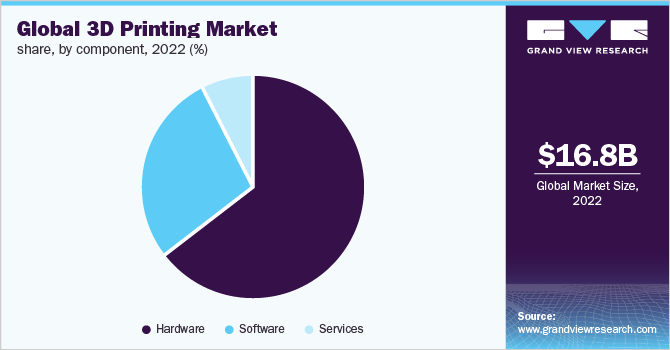
Based on components, the industry has been segmented further into hardware, software, and services. The 3DP hardware component segment has been bifurcated by printer type, technology, applications, vertical, and material. The software segment is further categorized by printer type and software type. The services segment is segregated only by the printer type. The software component segment is expected to witness significant growth during the forecast period.
Regional Insights
North America led the market and accounted for more than 33.34% share of the global revenue in 2022. This can be attributed to the extensive adoption of additive manufacturing in the region. North American countries, such as the U.S. and Canada, have been among the prominent and early adopters of these technologies in various manufacturing processes. Europe happens to be the largest region in terms of its geographical footprint. It is home to several additive manufacturing industry players with strong technical expertise in additive manufacturing processes. Hence, the European market emerged as the second-largest regional market in 2021.
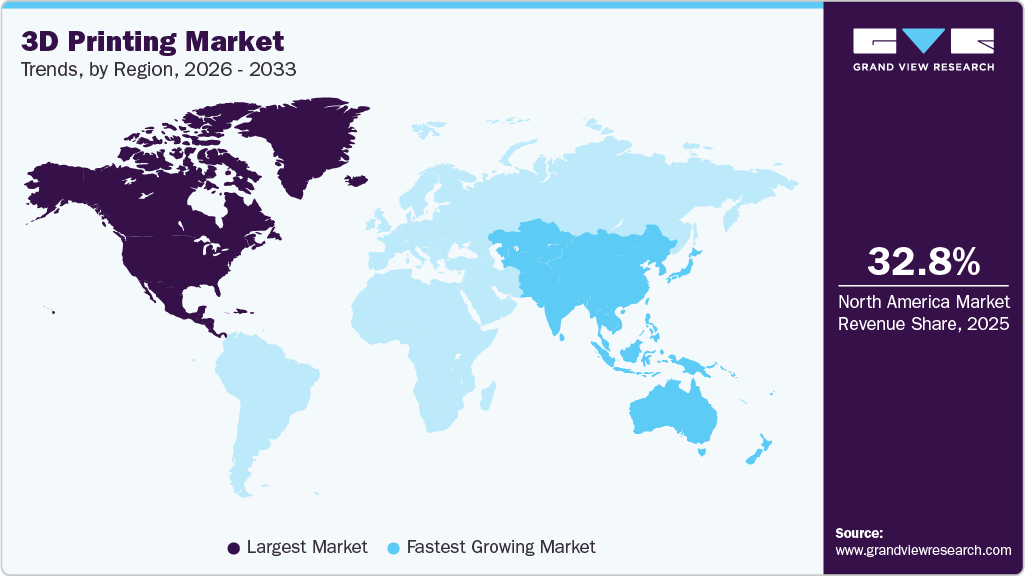
The Asia Pacific region is projected to expand at the highest CAGR during the forecast period. This rapid adoption of AM in the Asia Pacific can be attributed to the developments and upgrades across the manufacturing industry within the region. The Asia Pacific region is also emerging as a manufacturing hub for the automotive and healthcare industries. A stronghold on the production of consumer electronics, coupled with rapid urbanization, is also contributing to the region’s rising demand for three-dimensional printing.
Key Companies & Market Share Insights
Market players in the market are improvising 3D printing technology continuously in response to the growing demand for 3D printing applications from the automotive, healthcare, aerospace, and defense verticals for manufacturing purposes. The key players are identifying potential for business transformation by adopting additive manufacturing into new product development processes.
Market leaders like Stratasys Ltd. are moving beyond prototyping toward utilizing the agility that 3D printing can contribute to the complete manufacturing value chain. With its innovative line of 3D printers featuring Fused Deposition Modelling (FDM) and Selective Absorption Fusion (SAF) technology, the company can quickly and cost-effectively produce large end-use parts using additive manufacturing. Some prominent players in the global 3D printing market include:
- Stratasys, Ltd.
- Materialise
- EnvisionTec, Inc.
- 3D Systems, Inc.
- GE Additive
- Autodesk Inc.
- Made In Space
- Canon Inc.
- Voxeljet AG
3D Printing Market Report Scope
| Report Attribute | Details |
| Market size value in 2023 | USD 20.37 billion |
| Revenue forecast in 2030 | USD 88.28 billion |
| Growth Rate | CAGR of 23.3% from 2023 to 2030 |
| Base year for estimation | 2022 |
| Historical data | 2017 – 2021 |
| Forecast period | 2023 – 2030 |
| Quantitative units | Revenue in USD million/billion and CAGR from 2023 to 2030 |
| Report coverage | Revenue forecast, company ranking, competitive landscape, growth factors, and trends |
| Segments Covered | Component, printer type, technology, software, application, vertical, material, region |
| Regional scope | North America; Europe; Asia Pacific; South America; MEA |
| Country scope | U.S.; Canada; Mexico; U.K.; Germany; France; Italy; Spain; Japan; China; India; South Korea; Singapore; Brazil |
| Key companies profiled | Stratasys, Ltd.; Materialise; EnvisionTec, Inc.; 3D Systems, Inc.; GE Additive; Autodesk Inc.; Made In Space; Canon Inc.; Voxeljet AG |
| Customization scope | Free report customization (equivalent to up to 8 analysts’ working days) with purchase. Addition or alteration to country, regional & segment scope. |
| Pricing and purchase options | Avail customized purchase options to meet your exact research needs. |
Segments Covered in the Report
The report forecasts revenue growth at the global, regional, and country levels and provides an analysis of the latest industry trends and opportunities in each of the sub-segments from 2017 to 2030. Additionally, the report covers shipment estimates and forecasts as well as ASP qualitative analysis from 2017 to 2030. For the purpose of this study, Grand View Research has segmented the global 3D printing market report based on component, printer type, technology, software, application, vertical, material, and region:
- Component Outlook (Revenue, USD Million, 2017 – 2030)
- Hardware
- Software
- Services
- Printer Type Outlook (Revenue, USD Million, 2017 – 2030)
- Desktop 3D Printer
- Industrial 3D Printer
- Technology Outlook (Revenue, USD Million, 2017 – 2030)
- Stereolithography
- Fuse Deposition Modeling
- Selective Laser Sintering
- Direct Metal Laser Sintering
- Polyjet Printing
- Inkjet Printing
- Electron Beam Melting
- Laser Metal Deposition
- Digital Light Processing
- Laminated Object Manufacturing
- Others
- Software Outlook (Revenue, USD Million, 2017 – 2030)
- Design Software
- Inspection Software
- Printer Software
- Scanning Software
- Application Outlook (Revenue, USD Million, 2017 – 2030)
- Prototyping
- Tooling
- Functional Parts
- Vertical Outlook (Revenue, USD Million, 2017 – 2030)
- Industrial 3D Printing
- Automotive
- Aerospace & Defense
- Healthcare
- Consumer Electronics
- Power & Energy
- Others
- Desktop 3D Printing
- Educational Purpose
- Fashion & Jewelry
- Objects
- Dental
- Food
- Others
- Industrial 3D Printing
- Material Outlook (Revenue, USD Million, 2017 – 2030)
- Polymer
- Metal
- Ceramic
- Regional Outlook (Revenue, USD Million, 2017 – 2030)
- North America
- U.S.
- Canada
- Mexico
- Europe
- UK
- Germany
- France
- Italy
- Spain
- Asia Pacific
- China
- Japan
- India
- South Korea
- Singapore
- South America
- Brazil
- Middle East & Africa
- North America
Danh sách cửa hàng:
CT3D Group cung cấp dịch vụ in 3D và scan 3D cho khách hàng tại khu vực miền Bắc, bao gồm Hà Nội, Hải Phòng, Bắc Ninh, Hưng Yên, Hải Dương, Nam Định, Ninh Bình cùng các tỉnh thành lân cận. Khách hàng gửi file thiết kế hoặc yêu cầu qua website, hotline, Zalo, sản phẩm được sản xuất tại xưởng chính ở TP.HCM, Hải Dương và giao hàng tận nơi ra miền Bắc, đảm bảo chất lượng và tiến độ như khi làm việc trực tiếp. Bạn cần hỗ trợ dịch vụ có thể vào ngay trang liên hệ: https://in3d.edu.vn/contact-us/
Hotline: 0975 008 728 ( Mr Thái tiếp nhận)
Dịch vụ 3D cung cấp tại khu vực miền Bắc:
- In 3D: FDM (nhựa PLA, ABS, PETG, ASA), Resin/SLA độ chi tiết cao, in 3D kim loại SLM, MJP-MJF (PA12)
- Scan 3D: Quét 3D cầm tay và công nghiệp, thiết kế ngược (reverse engineering) từ mẫu vật thực tế
- Thiết kế 3D: Dựng mô hình từ bản vẽ, hình ảnh hoặc ý tưởng mô tả
- Kiểm tra 3D – đo lường: Đối chiếu kích thước bằng máy scan, kiểm tra GD&T
- Khuôn mẫu: Khuôn silicon, Vacuum Casting cho sản xuất loạt nhỏ
- Gia công bổ trợ: CNC xốp, CNC gỗ, hoàn thiện bề mặt (sơn màu, xi mạ)
- Khuôn silicon: Làm khuôn silicon và Đúc sản phẩm theo yêu cầu
Ngành nghề phù hợp tại khu vực miền Bắc:
Với mật độ khu công nghiệp dày đặc tại Hà Nội, Bắc Ninh, Hải Phòng, Hưng Yên, Hải Dương, dịch vụ 3D của CT3D đặc biệt phù hợp với doanh nghiệp cơ khí chính xác, điện tử, ô tô, cùng các đơn vị R&D cần tạo mẫu nhanh, chế tạo đồ gá (jig & fixture) hoặc phục hồi phụ tùng máy đã ngừng sản xuất.
Câu hỏi thường gặp
- CT3D có xưởng sản xuất tại miền Bắc không? Xưởng sản xuất chính của CT3D đặt tại TP.HCM và Hải Dương ( Hải Phòng mới). Khách hàng tại miền Bắc có thể được hỗ trợ ship hàng sau khi hoàn thiện bằng Viettel Post, Giao hàng tiết kiệm, Bưu điện hoặc Đường bay Nasco của VietnamAirline.
- Thời gian giao hàng mất bao lâu? Tùy độ phức tạp sản phẩm và đơn vị vận chuyển, thường từ 1-3 ngày sau khi hoàn thành sản xuất. Thời gian cụ thể được báo khi gửi báo giá.
- Có cần gửi mẫu vật thực tế để scan 3D không? Có, với dịch vụ scan 3D/thiết kế ngược, khách hàng cần gửi mẫu vật hoặc trao đổi phương án vận chuyển/khảo sát trực tiếp tùy theo kích thước và tính chất sản phẩm. Đối với những sản phẩm lớn, phức tạp khi vận chuyển thì CT3D có dịch vụ đo quét mẫu tận nơi.
CT3D Group cung cấp dịch vụ 3D toàn diện cho khách hàng tại khu vực miền Trung, bao gồm Đà Nẵng, Nghệ An, Hà Tĩnh, Khánh Hòa cùng các tỉnh thành lân cận. Khách hàng gửi file thiết kế, mẫu vật hoặc yêu cầu qua website, hotline, Zalo — sản phẩm được sản xuất tại xưởng chính ở TP.HCM và giao hàng tận nơi ra miền Trung, đảm bảo đúng chất lượng và tiến độ cam kết. Bạn cần hỗ trợ dịch vụ có thể vào ngay trang liên hệ: https://in3d.edu.vn/contact-us/
Hotline: 0975 008 728
Dịch Vụ 3D Của CT3D Tại Miền Trung
CT3D Group cung cấp dịch vụ 3D toàn diện cho khách hàng tại khu vực miền Trung, bao gồm Đà Nẵng, Nghệ An, Hà Tĩnh, Khánh Hòa cùng các tỉnh thành lân cận. Khách hàng gửi file thiết kế, mẫu vật hoặc yêu cầu qua website, hotline, Zalo — sản phẩm được sản xuất tại xưởng chính ở TP.HCM và giao hàng tận nơi ra miền Trung, đảm bảo đúng chất lượng và tiến độ cam kết.
Dịch vụ cung cấp tại khu vực miền Trung:
- In 3D: FDM (nhựa PLA, ABS, PETG, ASA), Resin/SLA độ chi tiết cao, in 3D kim loại SLM, MJP-MJF (PA12)
- Scan 3D: Quét 3D cầm tay và công nghiệp, thiết kế ngược (reverse engineering) từ mẫu vật thực tế
- Kiểm tra 3D – đo lường: Đối chiếu kích thước bằng máy scan, kiểm tra GD&T, kiểm tra bằng X-ray CT (NDT) cho chi tiết yêu cầu độ chính xác cao
- Thiết kế 3D: Dựng mô hình từ bản vẽ, hình ảnh hoặc ý tưởng mô tả
- Khuôn mẫu silicon: Làm khuôn silicon phục vụ Vacuum Casting cho sản xuất loạt nhỏ
- Sản xuất, thi công sản phẩm: Tượng composite, tượng polyresin, sản phẩm décor, thi công công trình composite theo yêu cầu
- Gia công bổ trợ: CNC xốp, CNC gỗ, hoàn thiện bề mặt (sơn màu, xi mạ)
Ngành nghề phù hợp tại khu vực miền Trung:
Với thế mạnh về du lịch, mỹ thuật, kiến trúc tại Đà Nẵng, Khánh Hòa và công nghiệp chế biến tại Nghệ An, Hà Tĩnh, dịch vụ 3D của CT3D phù hợp với các doanh nghiệp quảng cáo – sự kiện (mô hình trưng bày, mascot), kiến trúc – xây dựng (mô hình phối cảnh), cơ khí chế tạo (đồ gá, phục hồi phụ tùng), cùng các xưởng thủ công mỹ nghệ cần làm khuôn hoặc sản xuất mẫu số lượng nhỏ.
FAQ – Dịch vụ 3D tại miền Trung
-
CT3D có nhận làm tượng, mô hình trưng bày cho sự kiện tại miền Trung không?
Có, CT3D nhận sản xuất tượng composite, mô hình quảng cáo, mascot theo yêu cầu và giao hàng tận nơi phục vụ sự kiện, du lịch tại khu vực miền Trung. -
Dịch vụ kiểm tra 3D dùng để làm gì?
Kiểm tra 3D dùng để đối chiếu kích thước sản phẩm thực tế với bản vẽ thiết kế (GD&T), phát hiện sai lệch gia công, phù hợp cho doanh nghiệp cơ khí cần kiểm soát chất lượng chặt chẽ. -
Làm khuôn silicon có cần gửi mẫu vật không?
Có, cần mẫu vật hoặc file 3D chính xác của sản phẩm để làm khuôn, sau đó CT3D tiến hành đổ khuôn (Vacuum Casting) để nhân bản số lượng theo yêu cầu. -
Thời gian giao hàng ra miền Trung mất bao lâu?
Tùy độ phức tạp sản phẩm và đơn vị vận chuyển, thường từ 1-3 ngày sau khi hoàn thành sản xuất, được báo cụ thể kèm báo giá.
Dịch Vụ 3D Của CT3D Tại Miền Nam
CT3D Group cung cấp dịch vụ 3D toàn diện cho khách hàng tại khu vực miền Nam, với xưởng sản xuất chính đặt tại TP.HCM và phục vụ trực tiếp các tỉnh lân cận như Bình Dương, Đồng Nai, Bà Rịa – Vũng Tàu, Long An cùng khu vực Đồng bằng sông Cửu Long. Đây là khu vực có xưởng sản xuất thực tế của CT3D, nên khách hàng miền Nam có thể nhận tư vấn trực tiếp, gửi mẫu vật hoặc đến xưởng khảo sát khi cần. Bạn cần hỗ trợ dịch vụ có thể vào ngay trang liên hệ: https://in3d.edu.vn/contact-us/
Hotline: 0975 008 728
Dịch vụ cung cấp tại khu vực miền Nam:
- In 3D: FDM (nhựa PLA, ABS, PETG, ASA), Resin/SLA độ chi tiết cao, in 3D kim loại SLM, MJP-MJF (PA12)
- Scan 3D: Quét 3D cầm tay và công nghiệp, thiết kế ngược (reverse engineering) từ mẫu vật thực tế
- Kiểm tra 3D – đo lường: Đối chiếu kích thước bằng máy scan, kiểm tra GD&T, kiểm tra bằng X-ray CT (NDT)
- Thiết kế 3D: Dựng mô hình từ bản vẽ, hình ảnh hoặc ý tưởng mô tả
- Khuôn mẫu silicon: Làm khuôn silicon phục vụ Vacuum Casting cho sản xuất loạt nhỏ
- Sản xuất, thi công sản phẩm: Tượng composite, tượng polyresin, sản phẩm décor, thi công công trình composite theo yêu cầu
- Gia công bổ trợ: CNC xốp, CNC gỗ, hoàn thiện bề mặt (sơn màu, xi mạ)
Ngành nghề phù hợp tại khu vực miền Nam:
Với mật độ khu công nghiệp lớn tại Bình Dương, Đồng Nai, Long An, dịch vụ 3D của CT3D phù hợp với doanh nghiệp sản xuất, cơ khí chế tạo, điện tử cần tạo mẫu nhanh và chế tạo đồ gá; đồng thời phục vụ tốt nhóm khách hàng tại TP.HCM và lân cận trong lĩnh vực quảng cáo, kiến trúc, mỹ thuật, tôn giáo (tượng, phù điêu) nhờ lợi thế xưởng sản xuất tại chỗ.
Quy trình sử dụng dịch vụ:
- Gửi file thiết kế hoặc mẫu vật cần scan/kiểm tra qua website, Zalo, hotline — hoặc mang trực tiếp đến xưởng
- Nhận tư vấn công nghệ phù hợp và báo giá trong ngày làm việc
- Sản xuất tại xưởng TP.HCM theo đúng thông số đã thống nhất
- Giao hàng tận nơi hoặc khách hàng nhận trực tiếp tại xưởng
FAQ – Dịch vụ 3D tại miền Nam
1. Khách hàng tại miền Nam có thể đến xưởng CT3D trực tiếp không?
Có. Đây là khu vực có xưởng sản xuất chính của CT3D tại TP.HCM, khách hàng có thể đến khảo sát, gửi mẫu vật hoặc nhận sản phẩm trực tiếp tại xưởng.
2. Đặt hàng từ Bình Dương, Đồng Nai có mất phí vận chuyển không?
Với các tỉnh lân cận TP.HCM, thời gian và chi phí giao hàng thường thấp hơn so với khu vực xa, được báo cụ thể kèm báo giá sản phẩm.
3. CT3D có nhận thi công tượng, sản phẩm composite kích thước lớn tại miền Nam không?
Có, CT3D nhận sản xuất và thi công composite khổ lớn (tượng, mô hình quảng cáo, hạng mục trang trí công trình) tận nơi tại khu vực miền Nam.
4. Thời gian hoàn thành đơn hàng tại khu vực miền Nam có nhanh hơn các vùng khác không?
Có, do gần xưởng sản xuất trực tiếp, thời gian sản xuất và giao hàng tại miền Nam thường nhanh hơn so với các khu vực miền Trung, miền Bắc.
Tư vấn